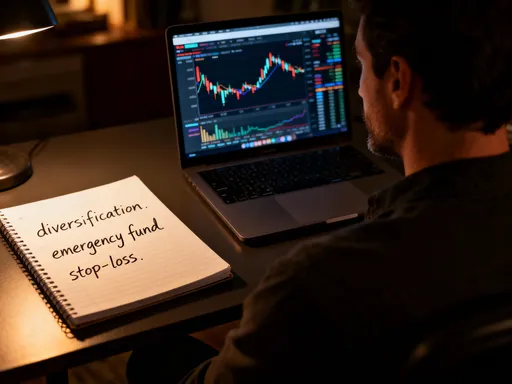
How I Stopped Gambling on Stocks and Built a Bulletproof Portfolio
Let’s be real—most of us didn’t start investing with a plan. I sure didn’t. I chased hot tips, jumped into trendy stocks, and called it “diversification.” Then came the market dip that wiped out months of gains. That wake-up call forced me to rethink everything. I discovered that true wealth isn’t about picking winners—it’s about avoiding devastating losses. This is how I transformed my chaotic portfolio into a structured, resilient system designed not for luck, but for long-term survival and steady growth. What began as a personal crisis became a financial transformation, rooted not in complex algorithms or insider knowledge, but in humility, discipline, and a shift in mindset. This is the journey from speculation to strategy, from fear to confidence, and from volatility to stability.
The Wake-Up Call: When My Portfolio Crashed
It started like many success stories do—with a few lucky breaks. I bought a tech stock on a friend’s recommendation, watched it double in six months, and felt like I had cracked the code. Encouraged, I doubled down. I added more speculative names, increased my exposure, and told myself I was being bold, not reckless. My portfolio grew, and so did my confidence. I checked it daily, sometimes hourly, feeling a rush every time the numbers ticked up. I wasn’t managing money—I was feeding an addiction to validation, mistaking volatility for progress.
Then, the market shifted. A combination of rising interest rates, inflation concerns, and sector-specific regulatory changes triggered a broad correction. The stocks I held, many of which were in the same high-growth, high-risk category, fell in tandem. Within three weeks, I lost nearly 40% of my portfolio’s value. What hurt most wasn’t just the money—it was the realization that I had no control. I couldn’t predict the downturn, I had no plan for it, and worse, I had no margin for error. My so-called diversification was an illusion. All my assets moved in the same direction because they were driven by the same forces—sentiment, momentum, and speculation.
That moment changed me. I began to question everything I thought I knew about investing. Was I really building wealth, or was I just riding a wave that could crash at any moment? I started reading research from respected financial institutions and long-term investors who emphasized capital preservation over aggressive growth. I learned that the most successful investors aren’t those who pick the most winners—they’re the ones who survive the worst downturns. The goal isn’t to get rich quickly; it’s to stay rich over time. That insight became the foundation of my new approach: prioritize risk management above all else.
Asset Allocation Is Not Just About Spreading Money Around
One of the most misunderstood concepts in personal finance is asset allocation. Many investors believe they’re diversified if they own a dozen different stocks across various industries. But true diversification isn’t about quantity—it’s about correlation. If all your investments rise and fall together because they respond to the same economic signals, you’re not diversified. You’re just spreading your bets across a single outcome. Real asset allocation means distributing your capital across different types of assets—such as equities, bonds, real estate, and cash equivalents—that react differently to market conditions.
Consider this: during periods of rising interest rates, growth stocks often struggle because future earnings are discounted more heavily. At the same time, short-term bonds or inflation-protected securities may perform better. In a recession, consumer staples and utilities tend to hold up better than cyclical sectors like travel or luxury goods. A well-structured portfolio takes advantage of these dynamics by ensuring that not all assets are vulnerable to the same risks at the same time. This doesn’t eliminate volatility, but it reduces the likelihood of catastrophic loss.
Effective asset allocation is strategic, not random. It starts with understanding your risk tolerance, time horizon, and financial goals. A young investor saving for retirement decades away might tolerate more equity exposure, while someone nearing retirement may prioritize capital preservation through higher allocations to fixed income. The key is alignment—your portfolio should reflect your life stage and objectives, not the latest market trend. I learned this the hard way. My initial portfolio was built on excitement, not logic. Once I shifted to a framework based on function rather than hype, everything changed. I stopped asking, “Which stock will go up?” and started asking, “What role should this asset play in my overall strategy?”
Another important insight is that asset allocation isn’t a one-time decision. It’s an ongoing process that evolves with your circumstances and the economic environment. Markets change, valuations shift, and personal priorities evolve. A static portfolio can drift far from its original intent without regular review. By treating asset allocation as a dynamic, intentional practice, I gained control over my financial trajectory. It’s not about predicting the future—it’s about preparing for multiple possible futures.
Why Risk Avoidance Outperforms Return Chasing
Most investment advice focuses on returns: “Earn 8% annually,” “Beat the market,” “Double your money in five years.” But this obsession with upside potential ignores a fundamental truth—avoiding large losses is more important than capturing every gain. Here’s why: a 50% loss requires a 100% gain just to break even. If you lose half your portfolio, you need to double what’s left just to return to where you started. That’s mathematically difficult and emotionally exhausting. In contrast, a portfolio that avoids deep drawdowns—even if it grows more slowly—has a much higher chance of long-term success.
Studies of long-term investor outcomes consistently show that behavior, not stock-picking ability, determines results. Investors who panic and sell during downturns lock in losses and miss the recovery. Those who stay the course, even with modest returns, benefit from compounding over time. The real enemy isn’t market volatility—it’s emotional decision-making fueled by fear and greed. By shifting my focus from “How much can I make?” to “How much can I afford to lose?”, I aligned my strategy with reality. I stopped trying to win big and started building a system that could survive almost anything.
Think of it like driving. You don’t get to your destination faster by speeding through red lights and ignoring traffic signals. You arrive safely by following the rules, maintaining a steady speed, and avoiding accidents. The same principle applies to investing. Consistent, measured progress beats erratic bursts of speed followed by crashes. A portfolio designed for resilience doesn’t aim to outperform every year—it aims to keep growing, even in bad years. That consistency allows compounding to work its magic over decades, not just months.
This doesn’t mean abandoning growth entirely. It means pursuing it intelligently. High returns often come with high risk, and not all risk is worth taking. I now evaluate every investment through the lens of risk-adjusted return—how much potential gain am I getting for each unit of risk I’m assuming? This disciplined approach has led me to favor assets with reliable income streams, lower volatility, and strong fundamentals over speculative bets with uncertain outcomes. Over time, this choice has delivered better results than chasing the next big thing ever did.
Building Your Core: The Foundation of Stability
Every strong structure needs a solid foundation, and the same is true for a resilient portfolio. I now divide my investments into two layers: the core and the satellite. The core is the anchor—typically 70% to 80% of the portfolio—made up of low-volatility, income-producing assets designed to preserve capital and generate consistent returns. This includes broad-market index funds, high-quality bonds, dividend-paying stocks with long payout histories, and cash reserves. These assets may not make headlines, but they provide stability when markets turn turbulent.
The purpose of the core is not to deliver explosive growth, but to serve specific financial functions. Some assets act as inflation hedges, maintaining purchasing power over time. Others provide regular income, which can be reinvested or used to cover living expenses in retirement. Still others offer liquidity, allowing me to respond to opportunities or emergencies without selling under pressure. By assigning clear roles to each component, I ensure that my portfolio works as a system, not a collection of random bets.
When building this foundation, I focus on durability over excitement. I look for assets with long track records, transparent structures, and economic resilience. For example, a globally diversified equity index fund gives exposure to thousands of companies across industries and countries, reducing single-point failure risk. A laddered bond portfolio spreads out interest rate and maturity risk, providing steady income regardless of rate movements. Real estate investment trusts (REITs) offer exposure to property markets without the burden of direct ownership. Each of these plays a defined role in maintaining balance.
What’s powerful about a strong core is that it reduces emotional pressure. When 80% of your portfolio is built to withstand downturns, you’re less likely to panic when the remaining 20% fluctuates. You gain the confidence to stick with your plan, knowing that even if some parts decline, the foundation remains intact. This psychological benefit is just as important as the financial one. Over time, the core does more than protect—it enables growth by creating a stable base from which to operate.
Layering Smart Risks: When and How to Take Controlled Bets
Once the core is established, there’s room to pursue growth—but only in a disciplined, limited way. I allocate a small portion of my portfolio—no more than 15% to 20%—to what I call “satellite” investments. These are higher-risk, higher-potential-return assets that I believe have asymmetric upside: the chance for significant gains with limited downside. This might include individual stocks in emerging industries, sector-specific funds, or small allocations to alternative assets like commodities or private equity funds available through regulated platforms.
The key difference between these controlled bets and my old gambling habits is intentionality. Each satellite investment is made with a clear rationale, a defined time horizon, and a predetermined exit strategy. I don’t buy because something is trending or because I fear missing out. I buy because I’ve done research, understand the risks, and have room in my portfolio to absorb a total loss without derailing my long-term goals. This mental shift—from impulsive to deliberate—has transformed how I engage with risk.
I also enforce strict position limits. No single satellite holding can exceed 2% to 3% of the total portfolio. This prevents any one bet from having an outsized impact. If it succeeds, great—I benefit. If it fails, the damage is contained. This approach allows me to participate in innovation and market opportunities without endangering my financial security. It’s like buying a lottery ticket with money you can afford to lose—not mortgaging your future for a chance at instant riches.
Behavioral discipline is crucial here. When markets heat up, it’s easy to feel pressure to increase risk exposure. I’ve learned to recognize those moments and pause. I ask myself: Am I acting based on evidence, or emotion? Is this addition aligned with my strategy, or am I chasing performance? Writing down my reasoning before making any satellite purchase helps me stay accountable. Over time, this structured approach has not only reduced my losses but also improved my gains by preventing overtrading and emotional exits.
Rebalancing Without the Stress: The Automatic Safety Reset
Even the best-designed portfolio can drift off course over time. As different assets perform differently, their weights shift. A booming stock market might push equities from 60% to 75% of your portfolio, increasing your risk exposure without you realizing it. Rebalancing is the process of restoring your original asset allocation by selling high and buying low—automatically locking in gains and buying undervalued assets. It’s one of the simplest yet most effective risk-control tools available.
I used to avoid rebalancing because it felt like market timing—what if I sell a winner too early? What if I buy something that keeps falling? But I’ve come to see it differently. Rebalancing isn’t about predicting the future; it’s about maintaining discipline. It ensures that my portfolio reflects my risk tolerance, not market sentiment. When I sell a portion of a high-performing asset, I’m not betting against it—I’m taking profits and restoring balance. When I buy more of an underperforming asset, I’m not gambling on a turnaround—I’m maintaining diversification.
To make this process effortless, I use automated tools offered by my brokerage platform. I set calendar reminders to review my portfolio every six months. If any asset class deviates by more than 5% from its target weight, I make adjustments. Some investors prefer a time-based schedule (e.g., annually), while others use threshold-based triggers (e.g., rebalance when allocation shifts by 5%). Either method works, as long as it’s consistent. Automation removes emotion and ensures that rebalancing happens regularly, not just when markets scare me into action.
The benefits are clear. Studies show that rebalanced portfolios often outperform non-rebalanced ones over the long term, not because they capture more upside, but because they reduce downside risk and maintain a steady risk profile. They also enforce a contrarian mindset—selling what’s popular and buying what’s out of favor—without requiring bold predictions. For me, rebalancing has become a ritual of financial hygiene, as routine and essential as checking my credit report or updating my will.
Mindset Over Metrics: Staying the Course When Markets Panic
Perhaps the most important lesson I’ve learned is that investing success depends more on psychology than on financial knowledge. Markets will always fluctuate. Bad years will happen. News headlines will scream crisis. The difference between those who succeed and those who fail isn’t access to better information—it’s the ability to stay calm and stick to the plan. My transformation from reckless gambler to disciplined investor wasn’t complete until I addressed my mindset.
I developed simple mental frameworks to manage fear and uncertainty. One is the “time horizon test”: when I feel anxious about a market drop, I ask myself, “Will this matter in ten years?” Most short-term volatility fades in the long view. Another is the “sleep test”: if I can’t sleep because of my investments, I’ve taken on too much risk. A third is the “journal rule”—I don’t make changes without writing down my reasoning first. This creates space between emotion and action.
I also limit my exposure to financial media. Constant updates amplify noise and create false urgency. I check my portfolio quarterly, not daily. I unsubscribe from speculative newsletters and mute social media finance groups. Instead, I focus on trusted, long-term sources—books, research papers, and advisors with fiduciary responsibility. This creates a calmer information environment, which supports better decision-making.
Finally, I remind myself that wealth is built in silence. The most powerful gains happen quietly, over years, not in dramatic spikes. Compounding doesn’t need my attention—it just needs my patience. By designing a portfolio that protects first and grows second, I’ve freed myself from the stress of constant monitoring and the temptation of quick wins. I no longer measure success by daily price movements, but by long-term progress toward financial security.
Looking back, I’m grateful for the crash that forced me to change. It taught me that real investing isn’t about beating the market—it’s about outlasting it. A bulletproof portfolio isn’t built on luck, hot tips, or timing. It’s built on structure, discipline, and a commitment to risk control. By focusing on what I can control—allocation, behavior, and process—I’ve created a system that works whether the market is up or down. And that, more than any single return, is the true measure of financial success.