Wandering Through Time: Corfu’s Hidden Architectural Soul
Ever walked down a cobblestone street and felt like you’ve stepped into another century? That’s Corfu for you—Venetian arches, pastel Ionian houses, and quiet courtyards whispering stories. I slowed down here, and suddenly, the island’s architectural magic unfolded. This isn’t just sightseeing—it’s feeling history through stone, light, and shadow. Let me take you where guidebooks rarely go, into the heart of an island shaped by centuries of cultural tides, where every alleyway tells a tale of resilience, adaptation, and quiet beauty. Corfu doesn’t shout its history; it lets you discover it, one sun-dappled wall at a time.
Why Corfu? The Allure of Slow Travel in a Crowded Mediterranean
Amid the Mediterranean’s whirl of sun-chasing tourists and packed ferry routes, Corfu stands apart—not for being untouched, but for offering something rarer: depth. While many Greek islands are celebrated for their whitewashed cliffs and turquoise coves, Corfu’s identity is etched in its architecture, a layered palimpsest of empires and eras. It is a place where history isn’t cordoned off behind museum glass but lives in the rhythm of daily life—children playing beneath arched gateways, shopkeepers sweeping mosaic thresholds, elders sipping coffee in arcaded squares shaded from the afternoon sun.
The island’s manageable size makes it ideal for slow travel. At just 39 miles long and 15 miles wide, Corfu invites exploration on foot, by bicycle, or with leisurely drives along winding coastal roads. Unlike destinations that demand constant movement to “see it all,” Corfu rewards stillness. Its charm unfolds not in grand monuments alone, but in the details: the curve of a wrought-iron railing, the way a shutter painted peacock blue casts a shadow across a cream-colored wall at 4 p.m., or the faint echo of footsteps in a vaulted passageway built five centuries ago. These are the moments that define a meaningful visit.
What sets Corfu apart is its architectural continuity. While other islands were reshaped by modern tourism, Corfu’s old towns and villages have retained their integrity, protected in part by UNESCO designation and in part by local pride. Travelers who choose to move slowly—lingering over coffee, returning to the same square at different times of day, striking up conversations with residents—discover a different pace of engagement. They begin to see patterns: how Venetian military logic shaped street grids, how Ionian elegance softened austere stone with color and light, how rural homes were built to harmonize with the land rather than dominate it.
Choosing Corfu for slow travel means choosing presence over productivity. It means resisting the urge to check off landmarks and instead allowing the island to reveal itself gradually, like a photograph developing in a darkroom. The reward is not a checklist of sights, but a deeper understanding of how architecture shapes memory, community, and identity. In a world that often feels transient, Corfu offers a rare opportunity to step into a living narrative—one written in limestone, slate, and sunlight.
First Impressions: Stepping Into Corfu Town’s UNESCO-listed Old Town
Arriving in Corfu Town, also known as Kerkyra, is like entering a stage set where history never left the scene. The capital rises from the sea on a narrow peninsula, its skyline marked by bell towers, fortress walls, and rooftops tiled in deep terracotta. Stepping off the ferry or bus, visitors are immediately drawn into the maze of the Old Town, a UNESCO World Heritage site since 2007. This is not a reconstructed historic district but a fully inhabited urban fabric, where centuries-old buildings house family apartments, family-run tavernas, and artisan workshops.
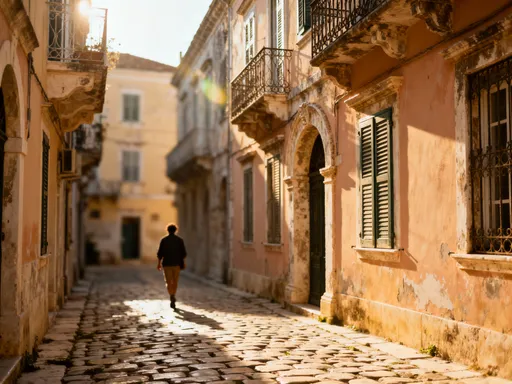
The first sensory impression is one of enclosure and intimacy. The streets are narrow, often no wider than a few feet, designed originally for defense and shade. Ochre, mint-green, and rose-colored buildings rise on either side, their facades adorned with wooden balconies heavy with potted geraniums. Iron grilles protect ground-floor windows, while above, shutters painted in contrasting hues—navy, forest green, burgundy—hint at the personalities within. The air carries the scent of jasmine, baking bread, and the faint brine of the sea just beyond the city walls.
One of the most iconic spaces is the Liston, a colonnaded promenade built during the French occupation in the early 19th century. Modeled after the Rue de Rivoli in Paris, it features graceful arches and pastel-hued buildings with wrought-iron railings. Locals gather here in the late afternoon, sipping frappé coffee at sidewalk cafes, watching children chase pigeons across the cobblestones. The Liston is more than a tourist attraction—it’s a social hub, a place where generations meet and the rhythm of daily life unfolds under the arches.
Equally significant is the Old Fortress, perched on a rocky islet connected to the mainland by a narrow causeway. Originally built by Byzantines and expanded by Venetians, it offers panoramic views of the town and the Ionian Sea. Inside, the fortress is a complex of ramparts, cisterns, and bastions, now used for concerts, exhibitions, and quiet contemplation. Its presence is a constant reminder of Corfu’s strategic importance—a prize fought over by empires, yet never fully conquered by time.
What makes Corfu Town so compelling is that its architecture is not frozen. It breathes. A 17th-century townhouse might now host an art gallery; a former stable could be a boutique hotel; a centuries-old fountain still trickles in a hidden courtyard. This active use of historic space gives the Old Town its authenticity. Travelers are not just observers but participants in a living urban tradition, where the past is not preserved behind glass but lived in, cared for, and gently adapted.
The Venetian Legacy: Arches, Forts, and the Rhythm of Stone
For over four centuries, from the late 14th to the late 18th century, Corfu was under Venetian rule, and the Republic of Venice left an indelible mark on the island’s architectural character. The Venetians were not only traders and sailors but master builders who understood the interplay between defense, climate, and urban design. Their legacy is visible in the island’s fortifications, street layouts, and building details—elements that were as functional as they were beautiful.
The most striking Venetian contribution is the Old and New Fortresses, both built to protect the town from Ottoman invasions. The Old Fortress, surrounded by seawater on three sides, features massive stone walls, bastions, and a network of underground tunnels. The New Fortress, on higher ground to the west, was constructed later to cover blind spots in the city’s defenses. Together, they formed a formidable system that helped Corfu resist multiple sieges—a rare feat in the eastern Mediterranean.
But Venetian influence extends beyond military structures. The urban grid of Corfu Town reflects Venetian planning principles: narrow, winding streets that confused invaders, wide enough only for foot traffic, and dead-end alleys that served as defensive traps. These same streets now offer natural cooling, shielding pedestrians from the summer heat. The use of *voltes*—vaulted stone passageways that run beneath buildings—is another Venetian innovation. These shaded corridors provided cool transit routes and are still used today by locals and visitors alike.
Architectural details abound. Look closely at doorways, and you’ll often see *tondi*—circular stone emblems, sometimes carved with family crests or religious symbols. These were not merely decorative; they signaled ownership, faith, or social status. Balconies, supported by intricately carved stone brackets, project over the streets, maximizing interior space while providing private outdoor areas. Many of these balconies are enclosed with glass or latticework, a later adaptation for weather protection, but their form remains true to Venetian design.
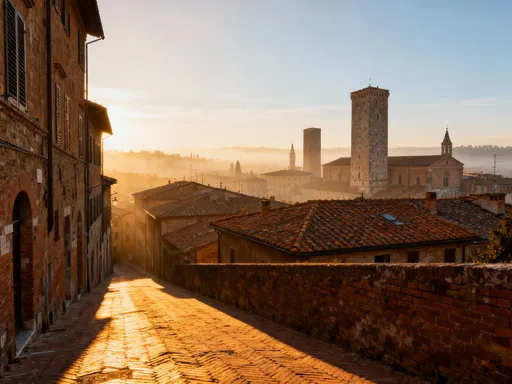
The materials themselves tell a story. Local limestone, quarried from the island’s hills, was used extensively for walls, arches, and staircases. Its warm, honey-colored tones give the Old Town its distinctive glow, especially at sunrise and sunset. Slate from nearby Panagia was used for roofing, creating a textured, durable cover that withstands both sun and storm. These materials, chosen for availability and performance, have aged gracefully, their patina adding to the town’s authenticity.
Even today, Venetian design principles influence new construction. Local building codes often require the use of traditional materials and styles, ensuring that modern additions blend rather than clash. The result is a cityscape that feels cohesive, where a 21st-century café can sit comfortably beside a 16th-century townhouse. The Venetians may have ruled long ago, but their architectural rhythm—practical, resilient, and subtly elegant—still pulses through Corfu’s streets.
Ionian Elegance: The Colorful Mansions and Garden Houses of the Aristocracy
While the Venetians shaped Corfu’s defenses, the 18th and 19th centuries brought a new architectural expression: Ionian elegance. Under British protection and influenced by Italian and French styles, Corfu’s upper class built grand urban residences known as *archontika*—two- or three-story mansions that combined symmetry, light, and luxury. These homes were not just dwellings but statements of status, culture, and cosmopolitan taste.
The neighborhoods of Campiello and Garitsa are prime examples of this architectural flowering. Campiello, nestled within the Old Town, was historically home to wealthy merchant families and aristocrats. Its narrow lanes open into small courtyards where mansions rise behind ornate gates. Facades are typically symmetrical, with tall windows, decorative cornices, and pastel stucco finishes in shades of ochre, rose, and sage. Wooden shutters, often painted in deeper tones, add contrast and protection from the sun.
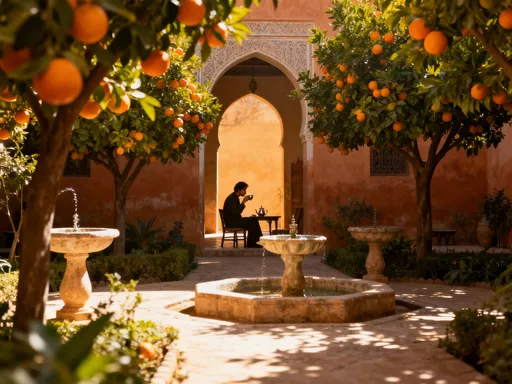
One of the most distinctive features of these homes is the *antresol*—a mezzanine floor between the ground and first levels, often used for storage or servants’ quarters. This design maximized vertical space in dense urban areas. Interior layouts were carefully planned to balance public and private life. Grand staircases led to reception rooms on the first floor, where families hosted gatherings beneath frescoed ceilings. Behind these formal spaces lay inner courtyards, often with fountains, citrus trees, and climbing vines—private oases in the heart of the city.
The Achilleion, though technically a palace built later in the 19th century for Empress Elisabeth of Austria, exemplifies the height of this aesthetic. Perched on a hilltop with sweeping views of the sea, it blends Neoclassical and Pompeian styles, with marble statues, grand terraces, and meticulously landscaped gardens. While more extravagant than typical *archontika*, it reflects the same values: beauty, refinement, and a deep connection to the natural world.
Today, many of these mansions have been repurposed with care. Some serve as museums, like the Museum of Asian Art, housed in the former Palace of St. Michael and St. George. Others have become boutique hotels, art galleries, or cultural centers. This adaptive reuse ensures that the spirit of these buildings endures. Visitors can step into a former drawing room and imagine the clink of crystal glasses, the rustle of silk gowns, the murmur of intellectual conversation—all within walls that still stand, still inspire.
The legacy of Ionian elegance is not just in the buildings themselves but in the way they shaped social life. Architecture facilitated connection—between family members, between neighbors, between the indoors and the outdoors. These homes were designed for living, not just for display. In preserving them, Corfu honors not only its past but the values of grace, hospitality, and cultivated beauty that they represent.
Rural Rhythms: Stone Villages and Vernacular Charm in the Hinterland
Leaving the capital behind, Corfu’s interior reveals a different architectural language—one rooted in the land, shaped by climate, and sustained by tradition. The island’s mountainous spine is dotted with stone villages like Pelekas, Afionas, and Old Perithia, each built to harmonize with the terrain. These settlements were not planned but grew organically, responding to the contours of the hills, the availability of water, and the needs of agriculture.
The dominant material is local stone, gathered from nearby fields and shaped by hand. Walls are thick—often two feet or more—providing natural insulation against both summer heat and winter chill. Roofs are covered in slate or terracotta tiles, sloped to shed rain and withstand strong winds. Windows are small and deeply set, minimizing direct sunlight while allowing for ventilation. These design choices were not stylistic but practical, born of necessity and refined over generations.
Old Perithia, perched on the slopes of Mount Pantokrator, is one of the oldest continuously inhabited villages on the island. Its labyrinthine streets are paved with stone, and homes are clustered tightly, sharing walls for added stability. Many buildings are partially ruined, yet their outlines remain, evoking a sense of continuity and resilience. The village church, dedicated to the Archangel Michael, stands at the center, a focal point for community life. Today, Old Perithia is a protected site, with restoration efforts underway to preserve its character.
Pelekas, further west, offers panoramic views of the coast and is known for its elegant 19th-century villas built by wealthy merchants. These homes blend rural stonework with refined details—wooden balconies, symmetrical facades, and interior courtyards. Unlike the fortified simplicity of mountain homes, these villas reflect a more cosmopolitan lifestyle, with large windows to capture sea breezes and views.
Afionas, a small village on the northwest coast, exemplifies coastal vernacular architecture. Houses are built close together, facing the sea, with flat roofs used for drying herbs and fish. Courtyards are essential spaces, used for olive pressing, food preparation, and family gatherings. The rhythm of life here is tied to the seasons—planting, harvesting, preserving—and the architecture supports this cycle.
What unites these villages is their authenticity. There are no artificial reconstructions or theme-park facades. These are real places, lived in by real people, where modern life coexists with tradition. A solar panel might sit beside a centuries-old well; a Wi-Fi router could be mounted near a carved stone lintel. This blend of old and new is not a contradiction but a testament to the adaptability of vernacular design. For travelers, visiting these villages is not about nostalgia but about understanding how architecture can be both timeless and responsive to change.
Living Architecture: How Locals Preserve and Repurpose the Past
In Corfu, preservation is not a top-down mandate but a grassroots effort, driven by pride, memory, and practicality. Historic buildings are not treated as relics but as resources—spaces to live in, work in, and share with visitors. This living approach to heritage ensures that architecture remains relevant, not frozen in a single era.
Across the island, families maintain ancestral homes with care, passing down not just property but knowledge—how to repair stone walls, how to restore wooden shutters, how to re-lay slate roofs. These skills are often learned through apprenticeship, from stonemasons and carpenters who have spent decades working with traditional materials. In recent years, local governments and cultural organizations have supported training programs to ensure these crafts survive.
Adaptive reuse is widespread. A former olive press might become a small museum; a converted stable could house a family-run taverna; a 19th-century mansion might open as a boutique guesthouse. These transformations are done with sensitivity, respecting the original structure while meeting modern needs. Insulation, plumbing, and electricity are added discreetly, without compromising historic features.
Cafes and shops in restored buildings contribute to the local economy while maintaining architectural integrity. In Corfu Town, a former warehouse now hosts an artisan chocolate shop, its vaulted ceilings and stone walls preserved. In a village square, a repurposed schoolhouse serves as a community center, hosting exhibitions and music events. These spaces are not sanitized for tourists but remain embedded in daily life.
Community initiatives also play a role. In Old Perithia, residents have formed associations to coordinate restoration projects and promote sustainable tourism. They welcome visitors but set boundaries—no loud music, no littering, no disrespect for sacred spaces. This balance allows tourism to support preservation without overwhelming it.
For travelers, engaging with this living architecture means more than taking photos. It means staying in a family-run guesthouse, buying from local artisans, asking questions with genuine curiosity. It means understanding that every restored balcony, every repaired fountain, is the result of someone’s labor and love. In honoring these efforts, visitors become part of the story—not as outsiders, but as respectful guests in a continuing tradition.
Traveling with Intent: A Practical Guide to Experiencing Corfu’s Architecture Slowly
To truly experience Corfu’s architecture, one must travel with intention. This means setting aside the urge to rush, to collect sights like souvenirs, and instead cultivating a slower, more observant way of moving through the island. It means allowing time for repetition—to return to the same square at dawn and dusk, to notice how light transforms a wall, how shadows shift across a courtyard.
Start with walking. Corfu Town is best explored on foot, without a fixed itinerary. Begin at the Old Fortress and wander downhill through the labyrinth of alleys, letting curiosity guide you. Follow architectural themes: seek out Venetian arches, then look for Ionian mansions, then find rural stone homes. Notice how materials change, how colors evolve, how space is used differently in various neighborhoods.
Visit early in the morning, when the streets are quiet and the light is soft. This is when the city feels most alive in its daily rhythms—bakers opening their ovens, cleaners sweeping steps, fishermen unloading their catch. Avoid midday crowds by retreating to shaded courtyards or quiet side streets. Return in the late afternoon, when golden light bathes the facades and the Liston fills with life.
Take day trips to inland villages, but go slowly. Spend an hour in Old Perithia, not just to see it, but to feel it. Sit on a stone bench, listen to the wind, watch how sunlight filters through olive trees. Have coffee in Pelekas and talk to the owner about the history of the building. These conversations often reveal more than any guidebook.
Practice mindful observation. Instead of snapping dozens of photos, take one thoughtful shot—of a weathered door, a pattern of tiles, a balcony overflowing with flowers. Ask yourself: What does this detail tell me about the people who built it? How has it changed over time? What does it say about life here?
Respect local customs. Ask permission before photographing private homes or people. Support preservation by staying in heritage guesthouses, buying from artisans, and choosing tours led by local historians. Travel off-season—spring or autumn—when the island is less crowded and the light is ideal for seeing architecture at its best.
Ultimately, experiencing Corfu’s architecture is about connection. It’s about seeing the hand of the craftsman in a carved stone, feeling the weight of history in a fortress wall, and recognizing that beauty can be both enduring and evolving. In a world that often feels disposable, Corfu offers a different message: that places can be loved, maintained, and passed on. To walk its streets is not just to witness history—but to become part of its continuation.